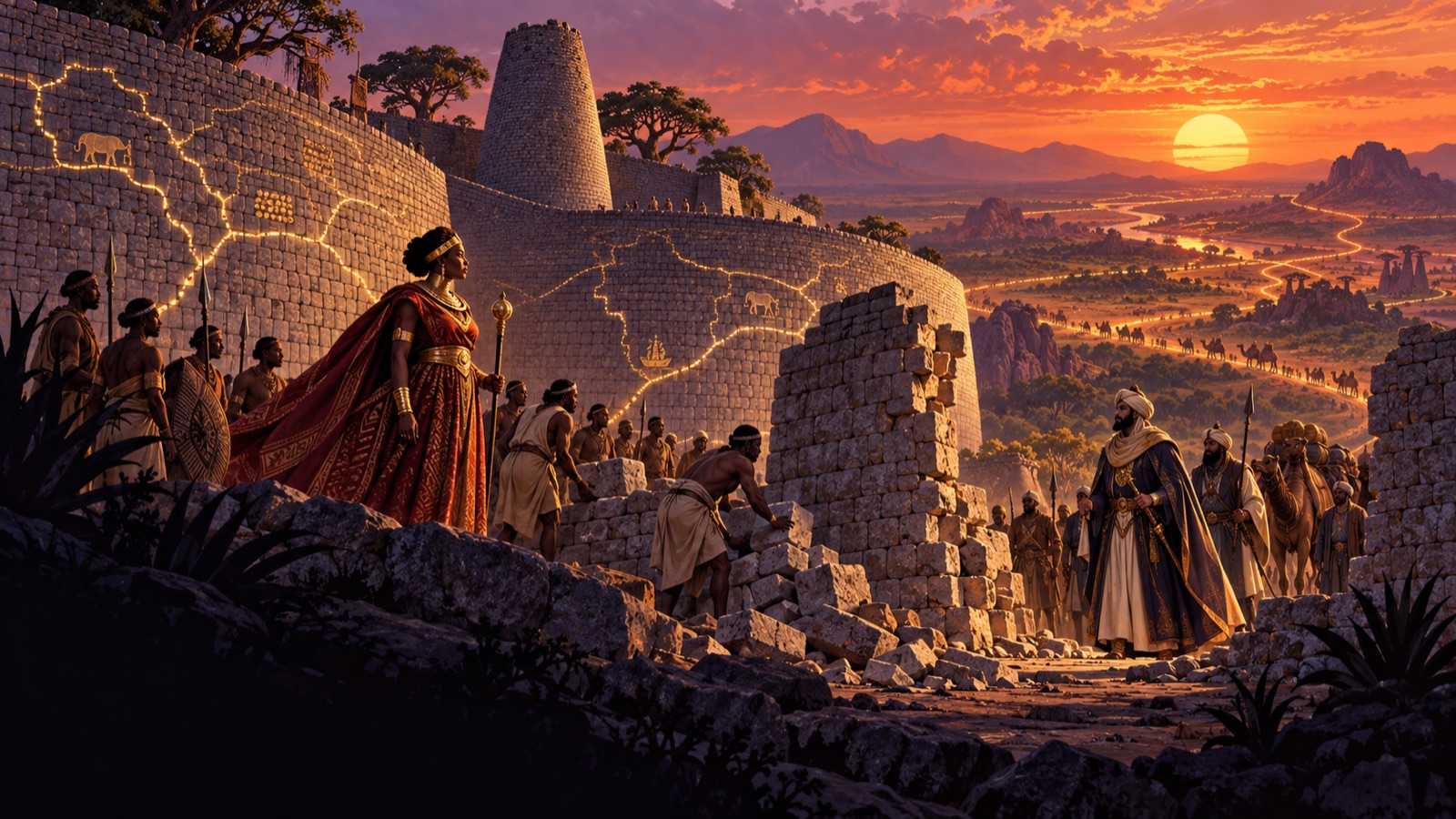
The opening
The characters meet at a lodge after hearing that a stolen Zimbabwe Bird will be sold to a private collector. A heritage guide named Nyatsimba helps them trace the seller through the ruins. He speaks about the walls with the familiarity of someone describing his own house.
As the party follows the stolen carving, passages change behind them. Imported beads and ceramics rise from the soil whenever someone repeats the old claim that outsiders built the city. Nyatsimba becomes furious at the lie, though he claims he has heard it only from tourists.
What the party is trying to do
Recover the stolen bird, identify who is using the ruins to support a false claim, and leave before the walls close.
A route through the campaign
- Track the buyer through an enclosure whose stones move whenever a promise is broken.
- Question masons and traders whose evidence shows wide trade without foreign construction.
- Recover the bird and discover that its base fits a hidden seat inside the Great Enclosure.
- Watch Nyatsimba place it without hesitation and call the walls by names absent from modern records.
- Face him as he names himself Nyatsimba Mutota and demands the return of every road that once paid tribute.
Possible endings
- Defeat Mutota and return the bird to public care.
- Rewrite the road covenants with the consent of the communities they affect.
- End the wall magic so the city's history can stand without supernatural proof.
History and invention
Great Zimbabwe was built by Shona communities and became an important political and trading center. Finds from China, Persia, and Kilwa show wide commercial connections, not foreign authorship. The contract bearing walls are a fictional change made for the adventure and deliberately reject colonial myths about the site's builders.
Content notes: colonial propaganda, economic exploitation, political violence.
For a D&D campaign idea, Walls of the Far Roads leaves a surprising amount of room for the party to wreck the plan in a useful way.
We played a tabletop RPG adventure in Great Zimbabwe last year, and the place did half the storytelling for us. This outline understands that.
I would ask each player what their character believes about trade and trust before session one.
The best part of Walls of the Far Roads is that the antagonist can be right about one important thing and still be impossible to support.
local achievement is such a strong pressure point for this story.
The second campaign beat in Walls of the Far Roads is the one I would build the trailer around: Question masons and traders whose evidence shows wide trade without foreign construction.
Saving Walls of the Far Roads for our next campaign.
That Great Zimbabwe backdrop is doing real work here. It does not feel pasted onto a generic dungeon.
I would keep the real history notes for after each Walls of the Far Roads session. My players love checking what was true once the spoilers no longer matter.
The job in Walls of the Far Roads is to recover the stolen bird, identify who is using the ruins to support a false claim, and leave before the walls close. There is a nasty moral problem inside that objective.
Session zero for Walls of the Far Roads: ask everyone what their character would never trade for safety. Then bring those answers back near the ending.
The 6 to 9 sessions length feels right for Walls of the Far Roads. Enough room to build suspicion without losing the thread.
I ran something adjacent to Walls of the Far Roads, but the party trusted the wrong faction almost immediately. I would keep that possibility open here too.
I would open Walls of the Far Roads right in Great Zimbabwe and let the party find the first clue before anyone explains it.
I can already hear my group arguing over whether to defeat mutota and return the bird to public care.
Walls of the Far Roads feels playable rather than merely clever. I know what the party is doing, what can go wrong, and where I can improvise.
I would move the reveal in Walls of the Far Roads one session earlier and let the players spend longer deciding what to do with it.
The choice to rewrite the road covenants with the consent of the communities they affect would absolutely split my table. Perfect.
The part where the party must track the buyer through an enclosure whose stones move whenever a promise is broken gave me the whole first session.
I would give the first clue in Walls of the Far Roads to the least scholarly character. It keeps the mystery from becoming one person reading while everyone waits.