The opening
The characters meet in a crowded bar outside Xi'an, where a retired surveyor talks about a sealed room beyond the known Terracotta Army pits. Their own search has already led them to the same rumor. A jade command tally connected to their quest may be hidden there. The next morning they hire a quiet guide named Ying Zheng, who arranges research access and seems amused by their interest in the emperor's tomb.
The public galleries feel normal at first. Then one warrior seems to be looking directly at them. A figure beside a doorway appears on the other side when they look back. Farther down, an entire row has changed its stance. Ying Zheng calls it poor lighting and leads them toward a maintenance corridor that does not appear on the site plans.
What the party is trying to do
Find the undiscovered chamber, recover the jade command tally, and get out before the site closes around them.
A route through the campaign
- Follow fresh clay footprints into a passage that staff insist has been sealed for decades.
- Watch one warrior vanish from its row and reappear ahead of the party with a hand resting on its sword.
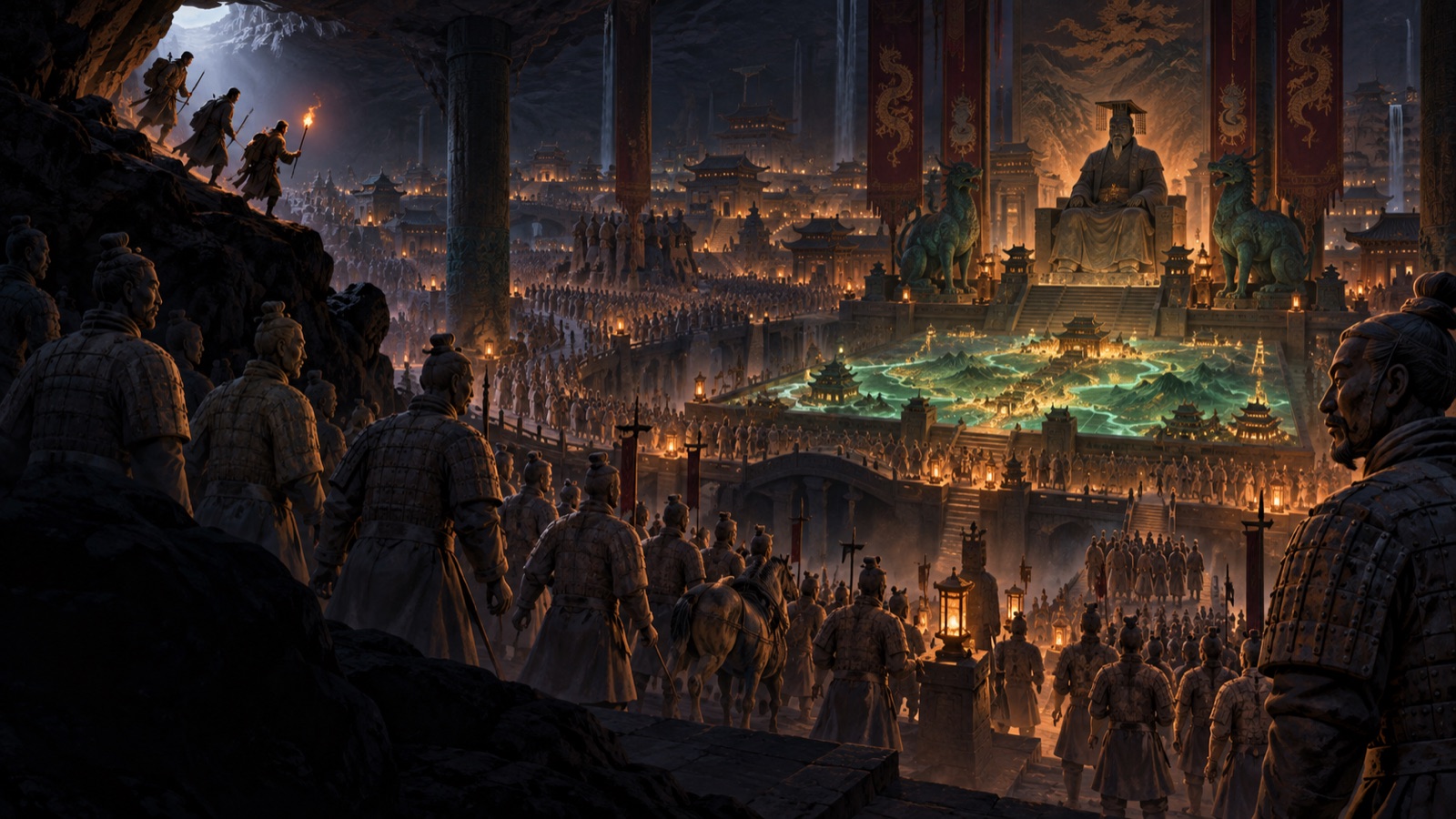
- Enter a hidden treasury where bronze weapons remain sharp and painted faces track every movement.
- Hear Ying Zheng warn the party about 因果报应, yīnguǒbàoyìng, and the karmic price of taking what belongs to the dead.
- Remove the command tally from the treasure pile, hear the stone doors close, and face thousands of clay heads turning at once.
Possible endings
- Defeat Qin Shi Huang and escape with the tally as the army collapses back into clay.
- Return the tally and bargain for safe passage by giving up another treasure or promise.
- Break the tally, freeing the warriors from the emperor and turning the tomb into a civil war of clay.
History and invention
Qin Shi Huang's mausoleum includes life size terracotta soldiers, horses, chariots, weapons, burial pits, and architecture arranged around a central tomb. UNESCO describes the plan as echoing the imperial capital. The awakening army, clay bureaucracy, and magical model of China are fictional changes made for the adventure.
Content notes: forced labor, imperial violence, burial spaces.
The second campaign beat in The Terracotta Emperor is the one I would build the trailer around: Watch one warrior vanish from its row and reappear ahead of the party with a hand resting on its sword.
Saving The Terracotta Emperor for our next campaign.
That Xi'an, China backdrop is doing real work here. It does not feel pasted onto a generic dungeon.
I would keep the real history notes for after each The Terracotta Emperor session. My players love checking what was true once the spoilers no longer matter.
The job in The Terracotta Emperor is to find the undiscovered chamber, recover the jade command tally, and get out before the site closes around them. There is a nasty moral problem inside that objective.
Session zero for The Terracotta Emperor: ask everyone what their character would never trade for safety. Then bring those answers back near the ending.
The 5 to 8 sessions length feels right for The Terracotta Emperor. Enough room to build suspicion without losing the thread.
I ran something adjacent to The Terracotta Emperor, but the party trusted the wrong faction almost immediately. I would keep that possibility open here too.
I would open The Terracotta Emperor right in Xi'an, China and let the party find the first clue before anyone explains it.
I can already hear my group arguing over whether to defeat qin shi huang and escape with the tally as the army collapses back into clay.
The Terracotta Emperor feels playable rather than merely clever. I know what the party is doing, what can go wrong, and where I can improvise.
I would move the reveal in The Terracotta Emperor one session earlier and let the players spend longer deciding what to do with it.
The choice to return the tally and bargain for safe passage by giving up another treasure or promise would absolutely split my table. Perfect.
The part where the party must follow fresh clay footprints into a passage that staff insist has been sealed for decades gave me the whole first session.
I would give the first clue in The Terracotta Emperor to the least scholarly character. It keeps the mystery from becoming one person reading while everyone waits.
My players would turn the first choice in The Terracotta Emperor into a three hour argument. I mean that as praise.
This would work nicely as a DND campaign for players who enjoy investigation but still want a clear objective. The Terracotta Emperor gives them both.
The buried grandeur mood in The Terracotta Emperor is exactly what my group likes.
My version of The Terracotta Emperor would lean harder into the machinery of empire.
One change I might make to The Terracotta Emperor: let the helpful NPC save somebody early. The later betrayal hurts more when the kindness was real.
For a D&D campaign idea, The Terracotta Emperor leaves a surprising amount of room for the party to wreck the plan in a useful way.
We played a tabletop RPG adventure in Xi'an, China last year, and the place did half the storytelling for us. This outline understands that.