The opening
A sightseeing flight over the Nazca Lines makes an emergency landing when the hummingbird figure appears to beat its wings. The pilot, Amaru, leads the characters toward a service road while insisting that heat distortion caused what they saw.
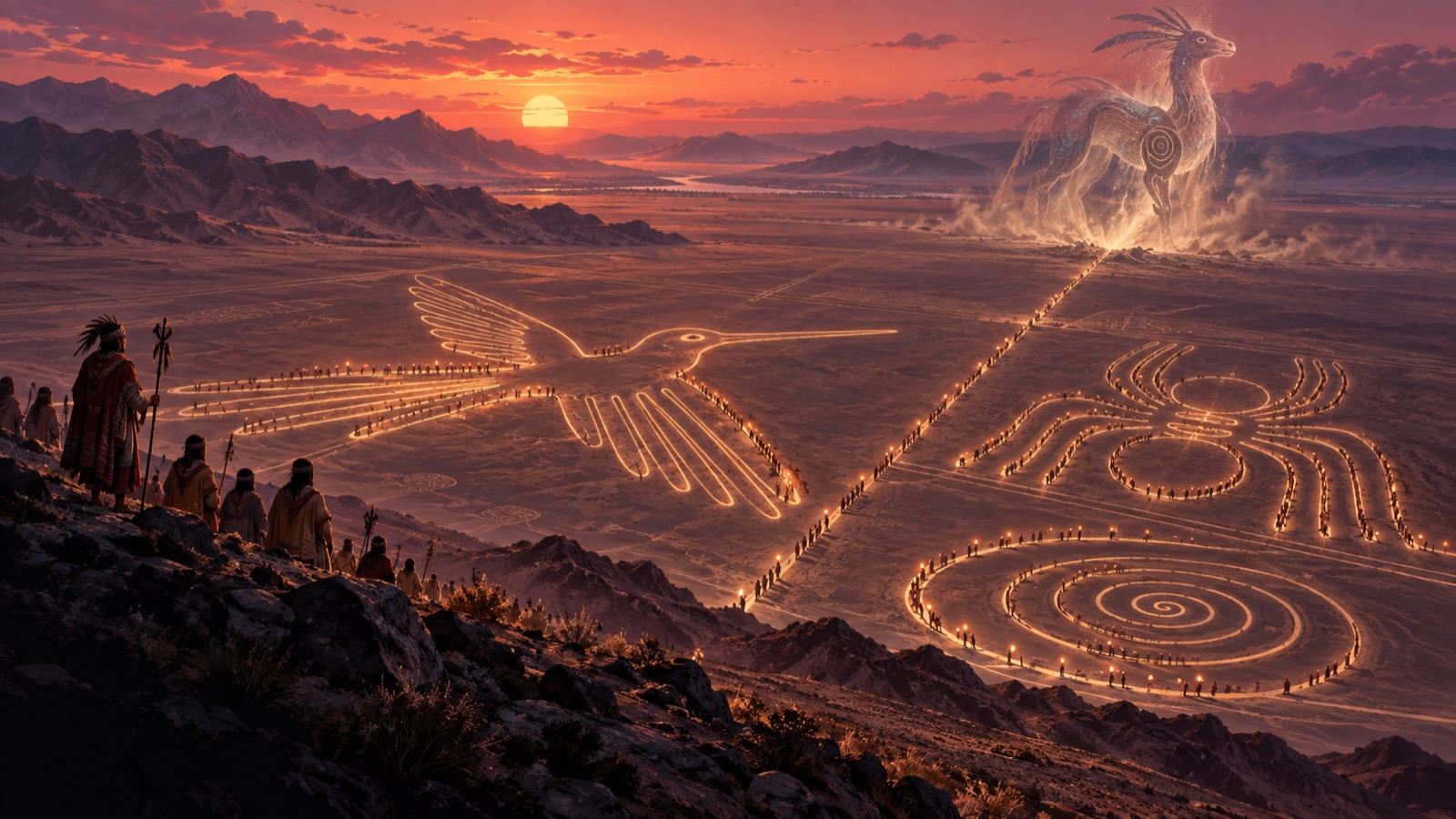
On the ground, the lines look ordinary until nightfall. Then stars settle into the grooves and something enormous moves beneath the desert crust. Amaru carries a map drawn long before aircraft existed, including the exact place where the plane came down.
What the party is trying to do
Repair the damaged geoglyph, reach safety, and stop whatever is waking beneath the desert.
A route through the campaign
- Walk the hummingbird path while its beak points toward a line missing from every survey.
- Find a camp whose occupants remember a town erased when a road cut through the spider figure.
- Watch Amaru speak to the lines and receive an answer through moving stones.
- Enter a buried chamber where the geoglyphs continue across the ceiling as chains.
- Reach the final knot as Amaru reveals his serpent form and asks the party to cut him free.
Possible endings
- Complete the old route and bind Amaru beneath the desert again.
- Draw a new figure that gives the serpent freedom within agreed boundaries.
- Destroy Amaru and preserve the lines as human history rather than living magic.
History and invention
Nasca and Palpa communities created large representational and geometric figures by removing darker surface stones to expose lighter ground. Their meanings remain debated, with ritual and astronomical interpretations among the proposals. This story rejects alien builder claims and treats the supernatural being as fiction.
Content notes: environmental disruption, forced labor, animal transformation.
I can already hear my group arguing over whether to complete the old route and bind amaru beneath the desert again.
Paths of the Sleeping Sky feels playable rather than merely clever. I know what the party is doing, what can go wrong, and where I can improvise.
I would move the reveal in Paths of the Sleeping Sky one session earlier and let the players spend longer deciding what to do with it.
The choice to draw a new figure that gives the serpent freedom within agreed boundaries would absolutely split my table. Perfect.
The part where the party must walk the hummingbird path while its beak points toward a line missing from every survey gave me the whole first session.
I would give the first clue in Paths of the Sleeping Sky to the least scholarly character. It keeps the mystery from becoming one person reading while everyone waits.
My players would turn the first choice in Paths of the Sleeping Sky into a three hour argument. I mean that as praise.
This would work nicely as a DND campaign for players who enjoy investigation but still want a clear objective. Paths of the Sleeping Sky gives them both.
The desert wonder mood in Paths of the Sleeping Sky is exactly what my group likes.
My version of Paths of the Sleeping Sky would lean harder into the shape of belief.
One change I might make to Paths of the Sleeping Sky: let the helpful NPC save somebody early. The later betrayal hurts more when the kindness was real.
For a D&D campaign idea, Paths of the Sleeping Sky leaves a surprising amount of room for the party to wreck the plan in a useful way.
We played a tabletop RPG adventure in The Nazca desert last year, and the place did half the storytelling for us. This outline understands that.
I would ask each player what their character believes about outside misunderstanding before session one.
The best part of Paths of the Sleeping Sky is that the antagonist can be right about one important thing and still be impossible to support.
collective maintenance is such a strong pressure point for this story.
The second campaign beat in Paths of the Sleeping Sky is the one I would build the trailer around: Find a camp whose occupants remember a town erased when a road cut through the spider figure.