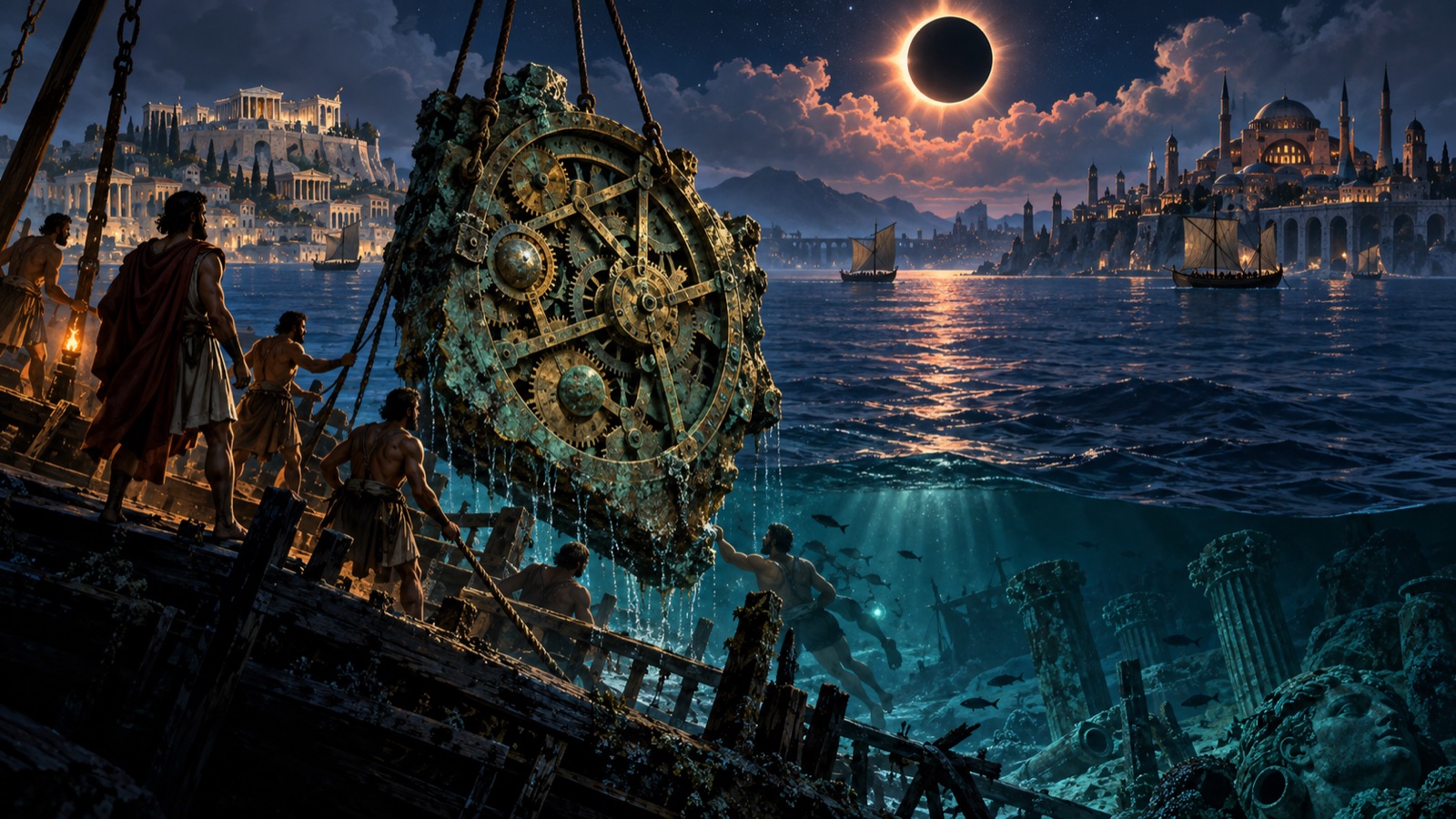
The opening
At a museum reception, the characters see a newly recovered gear from the Antikythera wreck. When a conservator turns it, every clock in the room loses eleven minutes and one guest disappears from the photographs on the wall. A salvage diver named Nikandros asks the party to join a return expedition before the authorities lock the site down.
The wreck changes each time they dive. Cargo moves between holds. Skeletons wear modern watches. Nikandros insists currents are shifting the debris, even after the party finds his name on an ancient passenger list.
What the party is trying to do
Recover the missing gears and stop the mechanism from removing more people from the present.
A route through the campaign
- Dive through a wreck whose rooms belong to different versions of the same voyage.
- Question survivors who appear only during the missing eleven minutes each night.
- Follow Nikandros into an eclipse shadow where a lost island city stands above the water.
- Assemble the final gear and see which people the machine intends to erase next.
- Confront Nikandros in the lighthouse while several histories fight to become real.
Possible endings
- Restore the lost city and accept the changes it makes to the modern coast.
- Break the mechanism and let fragments of several histories coexist.
- Stop Nikandros and preserve the present while carrying proof of those who were erased.
History and invention
The Antikythera mechanism was recovered from an ancient Mediterranean shipwreck. Its interlocking gears modeled calendrical and astronomical cycles, including eclipse patterns and the 19 year Metonic cycle. Time alteration and competing histories are original fantasy elements.
Content notes: drowning, loss of identity, erased communities.
The choice to break the mechanism and let fragments of several histories coexist would absolutely split my table. Perfect.
The part where the party must dive through a wreck whose rooms belong to different versions of the same voyage gave me the whole first session.
I would give the first clue in The Calendar Wreck to the least scholarly character. It keeps the mystery from becoming one person reading while everyone waits.
My players would turn the first choice in The Calendar Wreck into a three hour argument. I mean that as praise.
This would work nicely as a DND campaign for players who enjoy investigation but still want a clear objective. The Calendar Wreck gives them both.
The nautical mystery mood in The Calendar Wreck is exactly what my group likes.
My version of The Calendar Wreck would lean harder into competing futures.
One change I might make to The Calendar Wreck: let the helpful NPC save somebody early. The later betrayal hurts more when the kindness was real.
For a D&D campaign idea, The Calendar Wreck leaves a surprising amount of room for the party to wreck the plan in a useful way.
We played a tabletop RPG adventure in The Aegean Sea last year, and the place did half the storytelling for us. This outline understands that.
I would ask each player what their character believes about historical memory before session one.